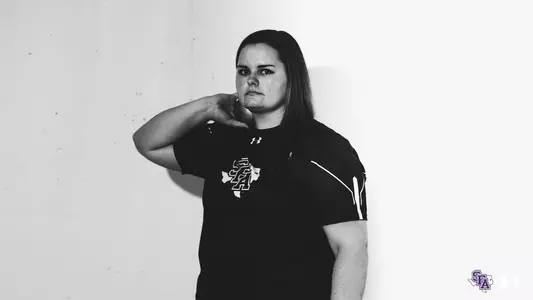
My Lumberjack Life: Mallory Dotson
5/14/2020 7:00:00 PM | Track & Field
SFA Athletics is continuing a new series called My Lumberjack Life. As May is Mental Health Awareness month, it seemed fitting to give our student-athletes a platform to detail their own mental health journey. These stories serve as testament to the strength and resolve of these athletes, as well as a spotlight on the tremendous stresses inherent with competing in college athletes.
"Dotson, you have to do better than that."
"You can't do it. You're too big."
Those words were forever embedded in my head.
Those words I heard every day in my seventh grade year when I was 12 years old. I heard it in the classroom because I didn't have the best grades. I heard words like that and more from bullies because I was too fat for their approval. I heard it in athletics because I couldn't run well. I was a big girl (I still am), and I couldn't run to save my life. Everyday my basketball coaches told me I wasn't good enough and that I should quit athletics. I didn't belong there. I wasn't an athlete.
After practice I would go home to a two-bedroom apartment filled with smoke from our neighbors through the vent. Our house had just flooded from a hurricane, it was all we had. My mom would be in her room resting, she was going through chemotherapy/radiation treatments for cancer while working by teaching college courses. She was exhausted. My brother was in his first year of college and my dad made sure everything was taken care of while teaching. I couldn't talk about what happened at school because our life was hard enough.
I didn't want to be a burden, so I kept it all inside. At 12 years old I was depressed, and I often thought about what would really happen if I wasn't there. Would anyone really notice if I just disappeared? I thought I was alone. I thought no one would miss me. In reality I had a whole army behind me who would do anything for me. I didn't see it. My mind didn't let me see it. I kept everything in. My mind told me I wasn't worth it.
The next year I moved schools to where my dad taught and coached. I made friends and no one messed with me, my dad was their coach. Freshman year I made the varsity basketball team, everyone told me it was because my dad was the coach. I believed them. I wasn't an athlete. Putting this in my head, I was moved down to the JV team. I didn't play much; I wasn't an athlete. I found a barbell because of that. I remember saying, "Oh yeah, I can do this." Another coach informed me however, that real female athletes don't lift because they were afraid to look like me.
Junior year of high school and 16 years old. I wasn't an athlete. I could free squat 315 pounds. I wasn't an athlete. I played most of the game during varsity basketball. I wasn't an athlete. I went to state in the discus and came home with a third-place medal. I wasn't an athlete. After practice at school I would have gymnastics practice. I wasn't an athlete. I'm too big for that category of people.
I checked into a hotel room that summer under a reservation from SFA Athletics for an official visit. Am I an athlete? No, couldn't be.
One conversation that summer with my dad changed everything. We were sprinting and I was slow. I told him it was fine because I wasn't an athlete. He looked at me confused, and realized I meant it. After what seemed like hours of a conversation between me and me dad, and many tears later, he said ten words that are now forever embedded in my head. "I believe in you; you have to believe in yourself." Maybe I was an athlete? He told me to have faith, to believe, and to trust.
Senior year I went on to become an all-state basketball player. I signed a National Letter of Intent to the SFA track and field team. I went to state and became the state champion in the shotput and the discus. For every season I have competed at SFA, I have always made the conference travel squad. I love a heavy barbell. I hate losing. Turns out they were all wrong, I was an athlete. I've learned not to brag about success, but to show people what a healthy head space can do. To show what you can accomplish by believing in yourself.
To me mental health has been and always will be something I don't like to admit that I have struggle with. There are still days I have where I don't feel like I belong when I see how much my teammates lift or how far they throw. Some days I feel like I can't keep up with them. That I don't belong. I feel like I'm still that 12-year-old girl. On those days, I talk to someone. I talk to a coach or, most of all, my dad.
Mental health is being able to say that I am not okay. It's looking alright on the outside but on the inside you're falling apart. Mental health is just as important as physical health. As athletes, we do our best to stay physically healthy all the time. It's so important to take the same amount of time, and make sure we are mentally healthy. If you're like me you're an expert of showing that everything is great on the outside but needs help on the inside.
Don't do that.
Get help.
This isn't something where you "suck it up."
This is where you say you're not okay.
- M
"Dotson, you have to do better than that."
"You can't do it. You're too big."
Those words were forever embedded in my head.
Those words I heard every day in my seventh grade year when I was 12 years old. I heard it in the classroom because I didn't have the best grades. I heard words like that and more from bullies because I was too fat for their approval. I heard it in athletics because I couldn't run well. I was a big girl (I still am), and I couldn't run to save my life. Everyday my basketball coaches told me I wasn't good enough and that I should quit athletics. I didn't belong there. I wasn't an athlete.
After practice I would go home to a two-bedroom apartment filled with smoke from our neighbors through the vent. Our house had just flooded from a hurricane, it was all we had. My mom would be in her room resting, she was going through chemotherapy/radiation treatments for cancer while working by teaching college courses. She was exhausted. My brother was in his first year of college and my dad made sure everything was taken care of while teaching. I couldn't talk about what happened at school because our life was hard enough.
I didn't want to be a burden, so I kept it all inside. At 12 years old I was depressed, and I often thought about what would really happen if I wasn't there. Would anyone really notice if I just disappeared? I thought I was alone. I thought no one would miss me. In reality I had a whole army behind me who would do anything for me. I didn't see it. My mind didn't let me see it. I kept everything in. My mind told me I wasn't worth it.
The next year I moved schools to where my dad taught and coached. I made friends and no one messed with me, my dad was their coach. Freshman year I made the varsity basketball team, everyone told me it was because my dad was the coach. I believed them. I wasn't an athlete. Putting this in my head, I was moved down to the JV team. I didn't play much; I wasn't an athlete. I found a barbell because of that. I remember saying, "Oh yeah, I can do this." Another coach informed me however, that real female athletes don't lift because they were afraid to look like me.
Junior year of high school and 16 years old. I wasn't an athlete. I could free squat 315 pounds. I wasn't an athlete. I played most of the game during varsity basketball. I wasn't an athlete. I went to state in the discus and came home with a third-place medal. I wasn't an athlete. After practice at school I would have gymnastics practice. I wasn't an athlete. I'm too big for that category of people.
I checked into a hotel room that summer under a reservation from SFA Athletics for an official visit. Am I an athlete? No, couldn't be.
One conversation that summer with my dad changed everything. We were sprinting and I was slow. I told him it was fine because I wasn't an athlete. He looked at me confused, and realized I meant it. After what seemed like hours of a conversation between me and me dad, and many tears later, he said ten words that are now forever embedded in my head. "I believe in you; you have to believe in yourself." Maybe I was an athlete? He told me to have faith, to believe, and to trust.
Senior year I went on to become an all-state basketball player. I signed a National Letter of Intent to the SFA track and field team. I went to state and became the state champion in the shotput and the discus. For every season I have competed at SFA, I have always made the conference travel squad. I love a heavy barbell. I hate losing. Turns out they were all wrong, I was an athlete. I've learned not to brag about success, but to show people what a healthy head space can do. To show what you can accomplish by believing in yourself.
To me mental health has been and always will be something I don't like to admit that I have struggle with. There are still days I have where I don't feel like I belong when I see how much my teammates lift or how far they throw. Some days I feel like I can't keep up with them. That I don't belong. I feel like I'm still that 12-year-old girl. On those days, I talk to someone. I talk to a coach or, most of all, my dad.
Mental health is being able to say that I am not okay. It's looking alright on the outside but on the inside you're falling apart. Mental health is just as important as physical health. As athletes, we do our best to stay physically healthy all the time. It's so important to take the same amount of time, and make sure we are mentally healthy. If you're like me you're an expert of showing that everything is great on the outside but needs help on the inside.
Don't do that.
Get help.
This isn't something where you "suck it up."
This is where you say you're not okay.
- M


4.3.26 | Carl Kight Invitational Recap
Monday, April 06
2.26.25 | Indoor Track and Field Conference Preview
Wednesday, February 26
6.4.24 | Southland Conference Statement x Track and Field - Rob Hansen
Tuesday, June 04
1.17.24 | Axe 'Em Insider x Episode 21 - Track and Field
Wednesday, January 17


