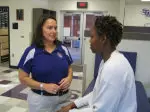
SFA Training Staff a Valuable Resource for Athletes
1/22/2010 12:00:00 AM | Women's Basketball
Jan. 22, 2010
NACOGDOCHES, Texas - Athletes are used to the spotlight. It's a way of life for them to have attention heaped upon them while they compete in front of crowds of fans. To truly succeed in sports, athletes almost have to crave the attention of playing in front of large groups of people, and they must thrive in the pressure such situations create.
For athletic trainers, the opposite is true. Their jobs are done on the periphery of what the average sports fan sees. They tape ankles and administer treatments before games. They serve water during timeouts. They distribute bags of ice at the end of contests. A foray into the public eye usually means a serious injury to one of their charges, which is something no trainer wants.
But, in a women's basketball game at Central Arkansas last week, Stephen F. Austin forward Schera Sampson and veteran athletic trainer Loree McCary got more attention than either wanted. For a few harrowing moments, they were the sole focus of the entire crowd gathered at UCA's Farris Center. It's a feeling neither will forget and one that both hope never to experience again.
"I've never felt that kind of relief, job-wise," said McCary, who has been on staff at SFA for nearly two decades. During that time she's seen all manner of injury and ailment. So what was so different about last Wednesday's incident in Conway, Ark.?
Sampson was knocked cold for approximately five minutes, during which time she seized violently, lost control of her bodily faculties and actually stopped breathing for nearly a minute before McCary helped to revive her.
"I've had concussions, and I've had people knocked unconscious, but I've never had anyone seize and stop breathing like that," McCary said. "You expect the seizure and convulsions to stop really fast. For it not to, and then some of the other things I saw happening -- for it all to turn out the way it has is pretty lucky. You don't really figure that it's going to go from seizure to stop breathing to loss of faculties. It can happen, but just in one-tenth of one percent of cases, and when it does, the result usually isn't good."
Wednesday's injury started with a hard screen on Sampson, who was defending under the UCA basket after draining a 3-pointer at the other end of the court. The impact caught her off-guard, and the first part of Sampson's body to make contact with the ground was her head.
McCary instantly left the Ladyjack bench and was at Sampson's side quickly. She noted that Sampson's body was locked in a seizure and the sophomore's eyes were rolled back in her head, indicating a loss of consciousness. Within 15 seconds, McCary had requested assistance from the local EMT crew and asked for an AED (automated external defibrillator) unit, but she was forced to just wait out the seizure at that point, as restricting Sampson's movement might have caused further injury.
The seizing stopped after approximately 45 seconds, and Sampson was still unconscious but breathing for the next two minutes. That's when the situation escalated. Without ever regaining consciousness, Sampson lost control of her bodily functions, and her breathing stopped. It was a moment McCary had prepared for at least once a year for the last two decades, but one she never thought she'd experience.
"Every fall in August we do CPR training with the athletic training students, and we have to be re-certified every year," McCary said.
That training takes place in a controlled environment in the midst of students and colleagues, and the resuscitation techniques are practiced on a mannequin. Those circumstances are far removed from a gym floor six hours from home with more than 1,000 people watching while a student-athlete's life hangs in the balance.
McCary says it's that training, though, repeated to the point that it becomes mundane, that enabled her to respond the way she did to Sampson's plight.
"It happened pretty quickly, but it felt like it was in slow motion," she said. "You do it enough times, you don't have to think about step one, step two, step three. You just react. You practice it enough so that when you do have to use it, it isn't one of those things where you have to stop and think each point through."
McCary instructed Yvette Perez, the graduate athletic training student tasked to women's basketball for this season, to get hold of an AED unit, then began administering CPR to Sampson.
"I opened the airway and gave two quick breaths," McCary said. "I was trying to figure out if she had a pulse. At that point, she just snapped awake. It was kind of like someone who's been submerged under water, and they all of a sudden wake up spitting out water."
McCary said the relief she felt at that moment was unlike anything she'd ever experienced. The tense situation -- and her role in it -- was far from over, though.
"My first thought was, `Sweet Jesus, she's awake.' And then it was `Schera, don't move!' She was trying to look around and see what was going on. There was more commotion around than I probably realized. By the time I asked for the AED a second time, Yvette already had the pads out and in place on Schera."
The next several minutes were spent keeping Sampson still and peppering her with head injury evaluation questions while waiting for the EMTs to arrive.
"From the time she woke up to the EMT crew getting there was probably less than 10 minutes," McCary said. "It seemed like forever."
McCary oversaw the application of a cervical collar and helped roll Sampson onto a backboard before she was placed on a gurney and loaded into an ambulance. Perez and assistant coach Taqueta Braxton made the trip to the emergency room with Sampson, to help comfort her and fill in the EMTs and hospital staff with any information they needed.
A couple of hours later, members of Central Arkansas' University Police Department brought all three back to the Farris Center to rejoin the rest of the team. The doctors had put Sampson through a battery of tests, exams and scans and deemed her healthy enough for the bus ride back to Nacogdoches.
"I was really shocked," McCary said. "I expected us to stay overnight. I definitely wasn't expecting us to take her home that night. Her neck hurt, her head hurt, but she was acting pretty normal. It was a huge surprise that there was nothing more serious than that going on."
Meanwhile, news of the incident had reached Nacogdoches almost immediately. UCA athletic director Dr. Brad Teague contacted SFA AD Robert Hill and kept in touch throughout the ordeal to answer questions and relay information.
"I think it's a shared belief that the welfare of our student-athletes is the No. 1 priority, regardless of which team they play for," Hill said. "When something like this happens, we're all one big family, and we'll do whatever it takes to help one another to take care of the situation. I want to thank Brad and his staff for their help. The cooperation between the two staffs was key to handling this situation."
SFA assistant AD for sports medicine Sandy Miller says he knew Sampson was in good hands with McCary. The two have worked together for nearly two-thirds of Miller's 29-year tenure at SFA.
"Loree's demonstrated several times that she's got great skills in this kind of situation," he said. "She has always handled this type of thing very well. ... Loree's got a great deal of common sense about her, which makes her an asset in emergency situations. She's always looking out for the welfare of the athlete, and she's got a good education base and good solid experience."
Having now experienced McCary's skill first-hand, Sampson echoed Miller's endorsement.
"I was told a lot of the stuff that happened when I was down," she said. "It is very comforting to know that we travel with people like this. It's a great feeling to know that she was there for me to do what she did. If not, it could have been a lot worse.
"I also appreciate the fact that Yvette was there, to go to the ER with me. She stayed with me the whole time, and I was never alone. It's comforting to know that if it were ever to happen again, to someone else, that our training staff is there with us and they have it covered."
For now, Sampson won't have to worry about a repeat of her own injury. She'll have to watch the games the way McCary does -- from the bench. It's been a week since the incident, and she's expected to miss at least a little more time before having any chance of getting clearance to play.
The hours and days following the injury weren't as tense as those immediately afterward, but they were less than relaxing. As part of the post-concussion protocol, McCary was charged with the task of waking Sampson up once an hour on the bus ride home and for the next several hours after returning to Nacogdoches. There were a couple of missed phone calls during that span that caused some minor panic for McCary, but Sampson eventually checked in both times.
"I'll be a lot more relaxed as soon as I can get her in to see Dr. (Mike) Randle," said a sleep-deprived McCary the morning after the injury. "It's one thing for the ER exam and the CT scan to come back normal. It's another thing entirely for our team doctor that we use for neurological injuries to look her over and say she's okay."
There are still several doctor's appointments and tests standing between Sampson and her return to the court. Like any athlete, she is eager to return to the spotlight. And, just like she always has, McCary will be there to make sure the spotlight is a safe place for Sampson to play.
-- SFA --